On Process: Songwriting Edition

For me, writing songs is the same process I used for writing the Café Chronicles or Waiting for Tango short stories. And since I’m sitting at Bourgeois Pig Café in Chicago and there is 20s music playing, I thought I’d talk about that process.
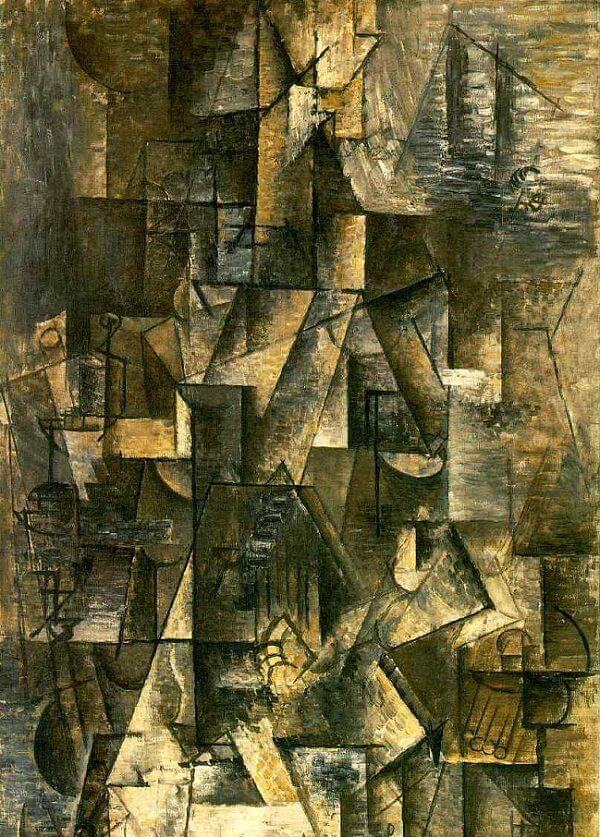
When I write a short story in the style of the Café Chronicles…I take that back. I think I write everything this way, including the erotic novels. Let me start over. When I write, I take a piece of what I’m experiencing, an object, a feeling, a memory, a person, and blow it up until it looks like Picasso’s “Ma Jolie.” From there, I examine all the parts until I find the few things on which I want to focus. I do this very quickly. If I wait too long or think about it too much, I start to censor. And that’s the last thing I want to do.

I should say that the first part of my song or storywriting process is not at all creative. At least it’s not creative in the way we like to think about creativity. It’s more observational. What do I see? What does it remind me of?

From there, I start writing. For example, one of my favorite short stories is simply called “The Woman in My Café” (Unpublished). The story is set in the now defunct, Saint’s Café in State College, PA. It starts with me describing the room a little. I then pull apart the muffin display case and, for me, that’s where the story takes off. I describe the muffins as little prisoners nobody wants. Perhaps, in retrospect, I should have made them puppies in a pound waiting to be adopted, but I tend to anthropomorphize objects. The point is, to me, they looked sad.

As I was looking at the muffins a woman walked in, ordered coffee, and left. The entire transaction took a minute or two, it was winter so she was completely bundled up, and she had her back to me the entire time. So, I blew her up and out of proportion and examined her. I made up an entire life for her. In fact, puppies do come into play later in the story.

The only real parts of the story were the descriptions of the walls and lighting. Though, I will still argue that the muffins looked sad.

I use that same process for writing songs. I will take something that I feel or see and delve into it. I will admit that when it came to songwriting, early on, I got a little carried away and let myself go to dark emotional places in order to really produce the emotion of the songs. This was an interesting stage in my process because I was just learning about the concept of the second arrow and how when things happen to us, the first arrow may sting a bit, but what we often do as humans is harp on how that event made us feel, and we wallow in it. That wallowing would be the second arrow. I was, essentially, stabbing myself with arrow after arrow in order to keep feeling the emotions.

The problem with, or perhaps the good thing about all the second arrows, is that they were all fictional. For example, a number of songs are about me getting hurt in a relationship. Well, the fact is that the relationship barely existed and was never a romantic relationship. Nevertheless, I held onto those emotions and kept plumbing their depths in order to write more songs. I will say that this process had a deleterious effect on my emotional well-being for a bit. I knew what I was doing, and I understood why, but it probably wasn’t the healthiest way to go about things.

Now, I can move in and out of those spaces and use them more effectively to write what I want and do so in a much healthier way. If you look at the songs, you’d assume that I’m still bullying my emotions for creative output, but now my process looks more like my short story process.

For example, one of my favorite new songs is called “Just Leave it Alone.” The opening verse goes like this:

Lying awake
Head underwater
I Turn toward the half-made bed
The memory foam
forgot your form
like you were never there

From the title, which is also the tag at the end of the chorus, and the first verse, you’d think that I’m still harping about that relationship. The title, though, comes from the name of a beer I saw at a brewery. And then, I anthropomorphized the mattress in a way that I thought was funny and evocative.

Is there still some real emotion in the song? Yes, but I’m not over here drowning in my own tears. (I hope you got it from the head underwater line. Sometimes, my metaphors are a bit of a stretch.) I wasn’t sitting in a hotel bar in Pittsburgh climbing into a bottle of bourbon just to write a song.

I’ve also started using ideas from outside my personal experience to write songs. Not long ago, I was reading a poem called “Conscience and Future Judgement” (Anonymous). I took one of the themes in the poem and combined it with the Buddhist concept of impermanence to write the song “Choices.” The process is the same. I deconstructed the poem and the concept, put pieces of myself in the mix, and wrote the song. This was fun as I went verse by verse, picked it apart, looked at it from different angles, and even borrowed words and reworked phrases from the poem as I went. If you line up my song and poem, you will see how I took the ideas and went in new directions with them.

I sat alone with my conscience,
In a place where time had ceased,
And we talked of my former living
In the land where the years increased;
And I felt I should have to answer
The question it might put to me,
And to face the question and answer
Throughout an eternity.
“Conscience and Future Judgment” (Anonymous)

I sit alone with my choices
On a Saturday night
And the clock stopped ticking
Right before my eyes
“Choices”

Again, there are bits of me in the song, but it really hangs on the poem.

For me, the process of creativity is more about observation than anything. I see the world, I see my own emotions and then simply deconstruct them and set them to music. In some ways, it is an easy process that doesn’t really adhere to the mystical ideas we have about creativity.

Just Leave it Alone

Inspiration is all around you. I’ve written short stories that start with pastries sitting in a display case in a coffee shop.

This song was inspired by the name of a beer at Antifragile, a local brewery in State College, PA. The beer was called “Just Leave it Alone.” I started thinking about all of the things I should just walk away from. Letting go, not clinging, is an important step in relieving our personal suffering. That is the point of the song.

Some Thoughts on Monthly Challenges

Normally, I eschew the monthly challenges that get scattered throughout the year. I find things such as “No Shave November,” “Dry January,” and the like somewhat problematic. I don’t really need to follow the crowd when it comes to what I want to do with my life. For example, this year, I decided to go dry for 28 days starting on a random day in mid-November. I did not because someone else decided that I should. I did it for myself. And as we know, there are other challenges throughout the year that range from the aspirational to the truly idiotic. That said, over the years, I have participated in two of these…sort of.

The first time I participated was about ten years ago. I decided to try NaNoWriMo. However, I didn’t really participate. I just wrote a novel in the month of November. I never went to the website or anything of that nature. I did it on my own, and again, I did it for myself. Since I enjoy the act of writing, I found it to be a nice way to spend a little time in November. In the end, I wrote a novel that had some merit for its genre. I’ll say that I’m pretty proud of it, though it’s not something I would ever publish under my real name.

I will say that I did like the structure of trying to get to 50,000 words in a month, and I planned my day around it. The first thing I would do every morning when I got to the coffee shop was to sit and write. I aimed for about 2000 words per day. That part was a little artificial, but it gave me a goal. I didn’t always adhere to the numbers, and never once did I get down on myself when I didn’t hit the 2000-word mark. The art of building words into beautiful sentences that told a story was the most important part for me.

Part of the problem with these sorts of challenges is they encourage less than mediocre effort. The whole thing becomes a numbers game. I understand the idea, which is just to get the ideas on paper and fix them later. The problem is that most people cannot fix the issues. It can leave one wholly unsatisfied. Since I avoided most of the rules of the challenge, I was very satisfied with my efforts.

This year, I am trying FAWM (February Album Writing Month). The idea is that you write 14 songs in the course of the month. This time, I actually went to the website and signed up. I am putting my songs on the website. I am recording the ones I can and uploading them to SoundCloud, and the ones I can’t record, I am putting the lyrics on the FAWM site. (Some of the recordings are a little on the rough side.) As of February 7th, I have posted six songs. Of course, just a few older songs can be found on my Instagram or on YouTube.

The upside of actually participating in the FAWM is that I am getting lovely positive feedback. The other positive is that although I’m trying to write new songs, I am also trying to use up the skeletons or fragments of older ideas floating around in my head. And honestly, if I don’t come up with 14 songs for the month, I don’t really care. I am, as always, more interested in quality over quantity and in enjoying myself.

The downside of the challenge is the problem I always come across.  The participants are spread out all over the world, and I’m stuck in the middle of nowhere, Pennsylvania, so the chance of collaboration is pretty much non-existent. This is a problem for my main goal in 2024, which is to play complete sets of original music with others. Ideally, I would need percussion, bass, and an additional guitar player. At my age, that is a bit of an ask, but we shall see.

Wish me luck.

Our Topography

I am genuinely surprised that I hadn’t posted this song before. It is one of my favorites. Sometimes, a good relationship, including friendships and romantic relationships, isn’t about the hobbies you have in common but the hard times you’ve been through. Just living life creates scars. Some we can see, some we cannot. When you are open and vulnerable, good things can happen.

“Your Big Day”

Art is the best way to deal with anything going on in your life. From daily stresses to deep-seated trauma to the joys of life, artists have always used their creativity to understand and take ownership of the events in their lives.

Once we get hold of an event or an emotion, we examine it from all sides and often exaggerate it for artistic effect. That is especially true of this song.

Whatever happens, express it, own it, and then go make more art.

This has turned out to be one of my absolute favorite songs.

R.S.V.P

This song took me about a year to write. I wrote the lyrics in October of 2022, and though I knew what I wanted to do musically, I had no idea how to create the sounds I wanted. I am close to what I want, but I am not quite there yet. That said, I wanted to share it.

The quality of the sound and the performance are not the best, but I am open to constructive ideas.

Revolutionizing Professional Football and Basketball: Embracing the Baseball Model for a Brighter Future

Professional sports leagues, especially football, and basketball, have been a source of entertainment and passion for millions of fans worldwide. However, it’s time to confront the challenges faced by these sports and pave the way for a more sustainable and thriving future. By developing a true minor league system akin to baseball, we can unlock numerous benefits, including improved play, increased revenue, and the elimination of pro sports from college campuses. Finally, we can provide athletes with alternative career paths while upholding the importance of education.

Implementing a comprehensive minor league system will undoubtedly enhance the quality of play in professional football and basketball. Much of baseball’s success lies in its well-structured minor league development system that allows players to refine their skills and adapt to the professional level gradually. By providing young talent with opportunities to grow, we can witness a smoother transition from college or high school sports to the professional arena, resulting in a more exciting and competitive product on the field.

With an enriched talent pool and an increased level of play, it’s only natural that revenue streams for football and basketball will soar to new heights. The minor league system will open doors for additional broadcasting contracts, merchandise sales, and sponsorships, as fans will have a chance to follow the development of potential future stars from their college days to professional careers. This boost in revenue will not only benefit the league owners but also filter down to the players and coaching staff, ensuring a more equitable distribution of wealth within the sport.

Additionally, developing a minor league system allows us to bid farewell to the issue of pro sports infiltrating college campuses. Many universities, once focused on academic missions, have shifted their priorities to cater to lucrative sports programs, resulting in compromised educational standards. By detaching professional football and basketball from colleges, these institutions can recommit to their education and regain their place as centers of learning and enlightenment.

Moreover, implementing a minor league system provides talented athletes with a viable alternative to traditional academia. While a college education remains invaluable, not all athletes have the same passion for academics or intend to pursue careers outside of sports. A structured minor league system allows these athletes to continue their pursuit of a professional sports career without compromising their educational choices. By offering specialized training and guidance, we can nurture well-rounded athletes who are prepared for both athletic and non-athletic future endeavors. Of course, just as in baseball, an athlete can still choose to go to college, but that would be a choice, not something that is forced upon them.

The introduction of a minor league system will also shift the focus of college sports away from the excessive pursuit of glory and profits. Currently, some programs prioritize winning at all costs, leading to scandals, recruitment violations, and the exploitation of young athletes. By providing a formal pathway for aspiring athletes, we can redefine the college sports landscape, emphasizing sportsmanship, fair play, and ethical conduct. This will not only restore the integrity of college sports but also foster an environment where students are developed with care and responsibility.

The proposed minor league system can be built on the existing infrastructure of college football and basketball. The top 32, in the case of football or 30 in the case of basketball, college teams can form the AAA tier, benefiting from the already established coaches, systems, and stadiums. The next 30 or so teams can make up the AA tier, and the remaining teams can constitute the single A tier. This hierarchical structure ensures a smooth and organized transition for players and teams alike, streamlining the entire process.

Teams could use existing stadiums and work out revenue-sharing deals with the colleges. I would add language in the contracts that would continue those relationships for 50 years to give colleges time to establish this new model. Of course, beyond that, teams could negotiate continued cooperation.

Furthermore, the implementation of a minor league system will also alleviate the burden of providing massive scholarship packages for college athletes. While colleges can continue to field sports teams, they can draw athletes from their student body, creating an environment where sports remain an integral part of college life without overshadowing the core academic mission.

The time has come for professional football and basketball leagues to embrace the success of baseball’s minor league model. By doing so, we can witness improved play, increased revenue, the removal of pro sports from college campuses, and provide talented athletes with viable career paths. The existing infrastructure makes this transition feasible, and it will ultimately foster a more balanced and sustainable future for both sports and education. It’s time to take this bold step and usher in a new era of success and prosperity for our beloved sports.

This article was my attempt at ChatGPT engineering. I did minimal editing to keep the focus on AI engineering.